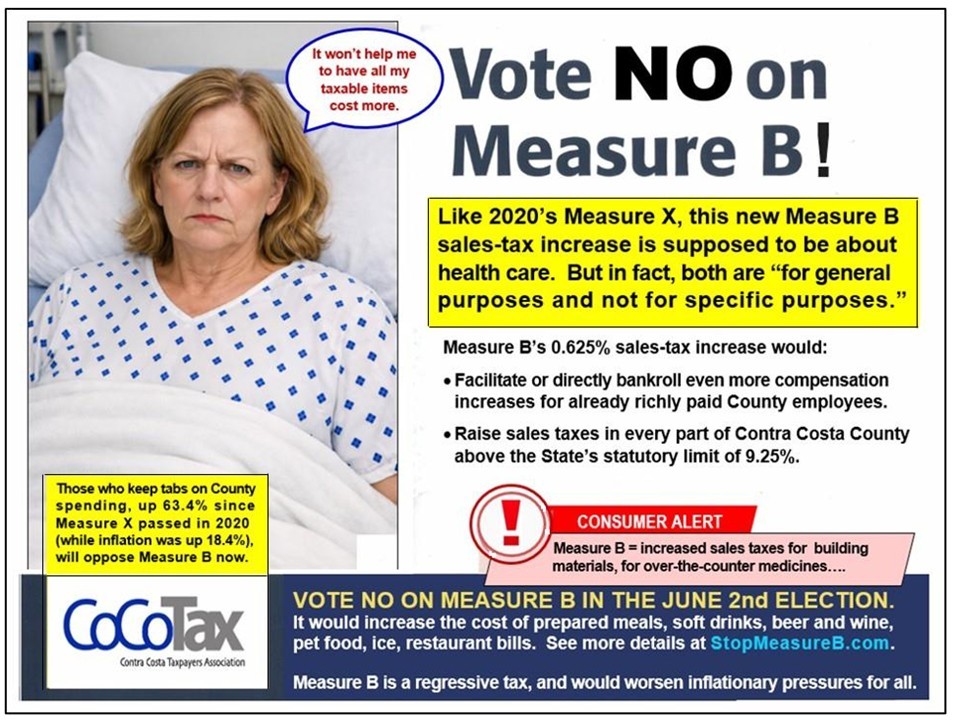
Measure B means a higher sales tax for Contra Costa.

Measure B would raise the county sales tax by five-eighths of a cent for five years — based on funding projections the county’s own Board had to correct the same day it voted.

Things you should know about Measure B

These points are drawn from county documents and published reporting on tax rates, timing, and the rollout of Measure B.

1

Measure B adds five-eighths of a cent countywide

Measure B would increase the county sales tax by 0.625%. Based on current California Department of Tax and Fee Administration rates, that would push the total sales tax to 10.875% in the county’s highest-tax cities.

2

Another countywide sales tax may be coming in November

State law already authorizes a regional transit tax measure for the November 2026 ballot, with planning documents describing a 0.5% increase for Contra Costa County if that measure goes forward.

3

The Board revised its own funding figure the same day it voted

On March 3, the Board corrected Recital H of the ordinance — changing “annual revenue losses exceeding $300 million” to “cumulative revenue losses of an estimated $239 million by 2029” — and then voted to place Measure B on the ballot anyway.

What would Measure B cost you?

Select your city or town to compare the current sales-tax rate with the rate if Measure B passes, and if both Measure B and the November transit tax pass.

Rates shown are combined sales-tax rates. Measure B adds 0.625%. The November transit scenario adds another 0.5%.

Current rate

Current rate for the selected city or area.

If Measure B passes

Current rate plus 0.625 points.

If both pass

Current rate plus 1.125 points.

Choose a location to see the comparison.

About those federal health cuts

The county says HR1 creates an emergency requiring immediate action. Its own documents tell a more complicated story.

1

The $300M “annual” loss was actually a 4-year cumulative total — corrected the same day the Board voted

County staff originally described $307 million in ongoing annual losses. Supervisor Andersen, the lone no vote, flagged the error. Staff confirmed it was a cumulative 4-year total. The Board revised Recital H of the ordinance that same day, lowering the figure to $239 million cumulative through 2029. Framing cumulative losses as annual makes the gap appear 7–8× larger than it is in any given year.

See the official documents →
2

Most HR1 provisions don’t take effect until 2027 or later — taxes start collecting in October 2026

Per the county’s own budget slide, federal legislative impacts are zero in FY25-26. Work requirements begin in January 2027. Six-month eligibility redeterminations begin in 2027. DSH hospital cuts are delayed until at least October 2027 per the county’s own presentation. Yet Measure B would start collecting taxes in October 2026 — a full year before most cuts even begin.

See the timeline →
3

DSH hospital cuts predate HR1 by 15 years and have been delayed more than a dozen times

The Disproportionate Share Hospital cuts were mandated by the Affordable Care Act in 2010 — not HR1. Congress has delayed them on a bipartisan basis more than a dozen times across four presidential administrations. Even the county’s own March 3 presentation acknowledges the latest delay extends to October 1, 2027. There is no basis for treating these cuts as inevitable or attributing them to the current Congress.

Read the DSH facts →

When do the cuts hit vs. when does Measure B collect?

The county says it must act now. The actual implementation calendar tells a different story.

HR1 Provisions vs. Measure B Tax Collection

Per the county’s own budget slide, federal impacts are zero in FY25–26. Measure B starts collecting in October 2026 — locking in five years of higher taxes before most impacts are even known.

2026 2027 2028 Oct 2026 Measure B taxes START collecting Jan 2027 HR1 work requirements 6-month redeterminations Oct 2027 DSH cuts (county’s own slide) Measure B tax collection begins HR1 Medicaid provisions take effect DSH cuts deadline (per county)

More tools for voters

Dig deeper into the facts: look up how sales-tax rates would change in your community, read the full myths-versus-facts page, explore the county’s reserve funds, track how the revenue-loss figure has been revised, and understand what’s really at stake on Medi-Cal.

?

Myths v Facts

Full side-by-side discussion of county funding claims, HR1, DSH cuts, timing, and alternatives — with the official county documents as evidence.

$

Tax Rate Lookup

Pick your city or town and compare your current rate to the rate if Measure B passes, and if both Measure B and the November transit tax pass.

Sales Tax Cap Issue

California law caps combined local sales taxes. Several Contra Costa cities are already near the limit — the tax may not be legally collectible everywhere without state legislation.

🏦

The County’s Spare Money

Contra Costa has $1.1 billion in unreserved general funds — more than three times the level financial experts recommend. The county could draw down reserves to cover any real funding losses without raising the sales tax.

📉

The Incredible Shrinking Revenue Loss

The figure used to justify Measure B has been revised downward twice — first from a $307 million annual loss to a $239 million four-year cumulative total, then reduced further after Congress again delayed hospital funding cuts that predate HR1 entirely.

🏥

Free Healthcare for our Undocumented Neighbors?

Part of the revenue loss driving Measure B involves shifting undocumented immigrants off full-scope Medi-Cal — which charges no premiums, copayments, or deductibles. Most Contra Costa taxpayers pay all three for their own coverage.

💰

Who’s Funding Yes on B?

The pro-Measure B campaign has raised $125,000 — 100% from two public employee union PACs whose own mission statements describe their core purpose as raising member wages and benefits.

📜

The Last Tax Hike: Measure X

The 2020 Measure X sales tax raised far more than projected and helped fund a Guaranteed Income Pilot for released inmates, an African American Wellness Hub, and an Office of Racial Equity. Now they want another one.

💰

Employee Compensation

Contra Costa County paid its approximately 9,500 full-time employees $1.7 billion in total pay and benefits in 2024. Current MOUs lock in roughly 20% cumulative wage increases through 2026-2027 -- regardless of whether Measure B passes.

In the News

Coverage of Measure B, the legal challenges, the cost of living in Contra Costa, and the broader squeeze on California households.

Bay City News Service — April 6, 2026 ✓ Taxpayers Win

Court strikes argumentative language from Measure B ballot question: Case No. N26-0456

A Contra Costa Superior Court judge ruled in favor of taxpayer petitioners Sandra Kallander and Dr. David Minor, ordering the Measure B ballot question rewritten before June 2. The court found the original wording argumentative and prejudicial, striking phrases that characterized a No vote as risking hospital closures and ordering the rate expressed as “(0.625%)” for clarity.

Read the coverage →
ContraCosta.news — March 30, 2026

Second lawsuit challenges false statements in Yes on B ballot arguments: Case No. N26-0554

A second legal challenge, Minor v. Connelly (Case No. N26-0554), filed March 27, targets the official ballot arguments filed by Measure B proponents — including county supervisors — rather than the ballot question itself. The petition alleges the proponents’ argument contains verifiably false claims.

Read the article →
Patch / InvestorsObserver — March 2026

Californians work 16 extra days a year just to pay the basics

A new analysis ranked California 5th worst in the nation for cost-of-living burden. Despite an average hourly wage of $40.93, residents must put in significantly more hours than in 2007 just to cover rent, groceries, and transportation — because costs have far outrun wages.

Read the report →
Gas Prices — Contra Costa County

California gas is among the most expensive in the nation — Measure B makes it worse

California’s pump prices are driven in large part by high sales tax rates, which apply at the pump. Measure B’s 0.625% increase would apply to every gallon filled, hitting commuters and working families hardest.

See Contra Costa gas prices (GasBuddy) →
Local News Matters

Contra Costa supervisors vote to place sales tax on June ballot despite revised funding figures

Coverage of the March 3 board meeting where staff revised the loss estimate downward but the board proceeded with the vote.

Read the article →
ContraCosta.news

Lone no vote cites misleading $300M annual figure; county confirms number is cumulative

Supervisor Andersen’s dissent and her identification of the “ongoing vs. cumulative” error in county staff materials before the March 3 vote.

Read the article →
Press Contact

Reporters: contact the campaign for details on the lawsuits and the opposition’s case

Media inquiries about Case Nos. N26-0456 and N26-0554, or the campaign’s record, are welcome. We respond quickly.

Email the campaign →
Why it matters

Measure B would make everyday purchases more expensive across Contra Costa County — and may not be legally collectible everywhere without state action.

What is on the table

  • Measure B is a general sales tax — revenue goes to the general fund with no dedicated purpose.
  • The county’s own ballot language says the tax runs for five years.
  • The county estimated the measure would raise about $150 million annually.
  • Collection is set to begin October 1, 2026 — before most HR1 impacts are even felt.
  • A court ruled the original ballot question argumentative and prejudicial (Case No. N26-0456); a second lawsuit (N26-0554) challenges the Yes on B ballot arguments as false and misleading.

Key questions voters should ask

Before voting yes on any tax measure, it is reasonable to ask:

  • Why did the county present a $307M annual figure that turned out to be a 4-year cumulative total of $239M?
  • Why lock in a 5-year tax before federal and state rules are even finalized?
  • Is the sales tax cap resolved for all Contra Costa cities without state legislation?
  • How can the Yes side claim a $1.5 billion loss when the county’s own corrected projections show $509 million over six years?
  • Have alternatives — including the November state ballot — been fully considered?

Volunteer for the No campaign

Help us get accurate information to Contra Costa County voters before June.

Ways to help

We are looking for supporters who can help spread the word and build the campaign as the election approaches.

ResearchLetter WritingSocial Media PostingHost a Neighborhood MeetingPost Signs

Contact the campaign

Form not opening? Email us directly at marc@cocotax.org.