How the revenue loss figure has changed
County materials: “$307 million in ongoing annual losses”
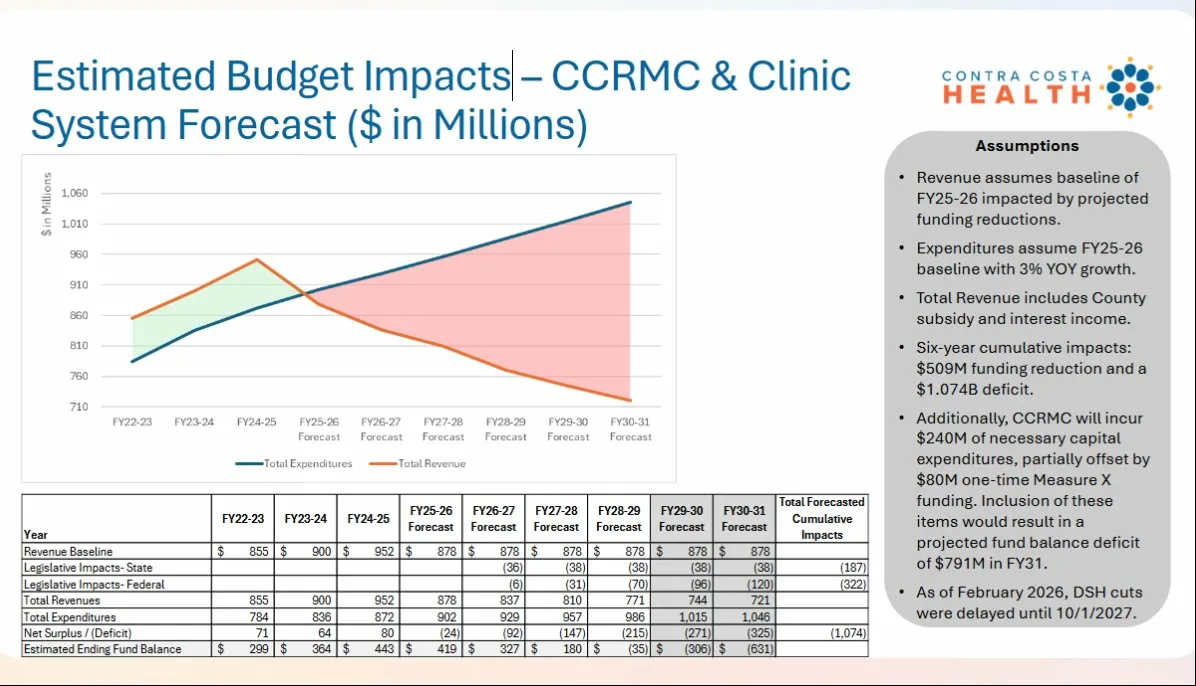
Before the March 3 Board of Supervisors vote, county materials — including content posted on the county website — described the projected loss as $307 million in ongoing annual losses. At that rate, the five-year cost to the county would approach $1.5 billion. This figure was prominently cited by Measure B supporters as proof of an emergency requiring immediate tax action.
CoCoTax identifies the error; Supervisor Andersen cites the finding and votes No; staff revises Recital H
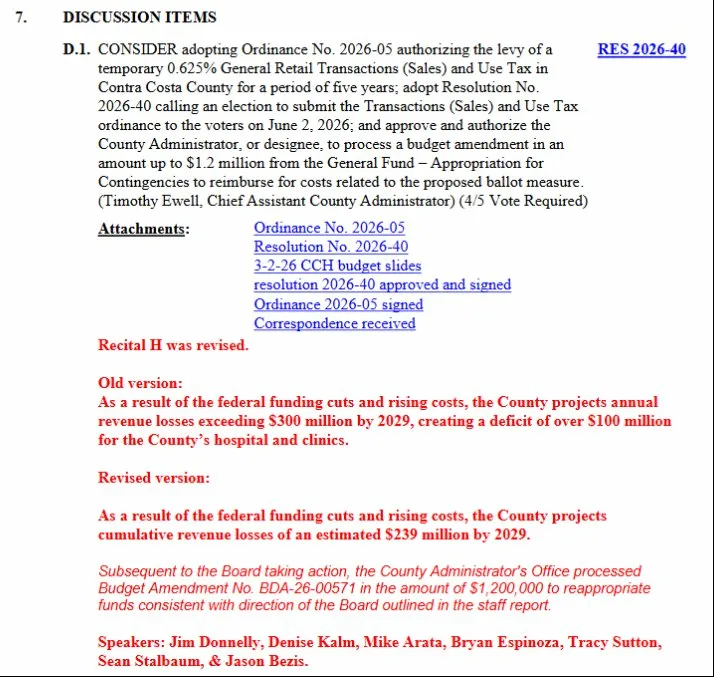
The Contra Costa Taxpayers Association identified that the $307 million figure was a cumulative four-year total, not an annual loss. Supervisor Candace Andersen, the lone no vote, cited this finding in her remarks before the board voted and gave it as a key reason for her opposition. County staff confirmed the error on the record. The board revised Recital H of Resolution 2026-40 — the document placing Measure B on the ballot — changing the figure to “cumulative revenue losses of an estimated $239 million by 2029.”
It is important to note that the corrected $239 million figure already incorporates a Congressional delay of Disproportionate Share Hospital (DSH) payment reductions to September 30, 2028, enacted by the Consolidated Appropriations Act of 2026 (H.R. 7148) and signed into law in February 2026 — weeks before the board vote. The $239M is not a pre-DSH-delay number; the DSH delay is already baked in.
Congress will almost certainly delay DSH cuts again before 2028 — shrinking the figure further
DSH cuts were first mandated by the Affordable Care Act in 2010. In the 15 years since, Congress has delayed them on a bipartisan basis more than a dozen times, across four presidential administrations and multiple changes in House and Senate control. They have never once actually taken effect.
The current deadline is September 30, 2028. There is no reason to expect this deadline to be treated differently from all the previous ones. Hospitals that serve large Medicaid and uninsured populations — including safety-net hospitals like Contra Costa Regional Medical Center — have powerful Congressional advocates on both sides of the aisle, and the political incentives for another extension remain exactly what they have been for 15 years.
Document: Contra Costa Health Presentation — March 3, 2026
Document: Revised Measure B Ordinance — March 3, 2026
Why this matters for voters
The ballot argument for Measure B was written after these corrections. Voters deserve to know that the figure used to justify the emergency has already been cut by more than 90% on a per-year basis — from $307 million per year to roughly $60 million per year — and that even the corrected figure rests on a DSH deadline that Congress has never once honored.
A county that holds over $1.1 billion in unreserved general fund reserves can absorb $60 million per year in health funding losses without asking every shopper in Contra Costa to pay a higher sales tax for five years. And if DSH cuts are delayed again — the overwhelming historical likelihood — even that figure falls further.
The right question for voters is not “should we protect health services?” — of course we should. The right question is: did the county give us accurate numbers, and is a five-year countywide sales tax the right tool for a problem whose actual size is still shrinking?
The timing mismatch is still unaddressed
Per the county’s own March 3 budget slide, federal legislative impacts on health services are zero dollars in FY 2025–26. Work requirements under HR1 begin in January 2027 at the earliest. DSH cuts are delayed until at least September 2028 — and, based on history, likely longer.
Measure B taxes start collecting in October 2026 — before any of the major HR1 provisions take effect. Voters would be locked into five years of higher taxes to address a problem whose actual scope is still being determined by Congress, the courts, and state regulators.
Sources
- Contra Costa County Board of Supervisors meeting, March 3, 2026 — board video and minutes (Local News Matters, ContraCosta.news)
- Resolution 2026-40 (original and revised), Recital H — Contra Costa County Clerk of the Board
- Contra Costa Health Budget Forecast Slides, RES-2026-40, presented March 2, 2026 (DSH footnote: “As of February 2026, DSH cuts were delayed until 10/1/2027”)
- Consolidated Appropriations Act, 2026 (H.R. 7148), signed February 2026 — DSH delay extended to September 30, 2028
- Congressional Research Service, Medicaid DSH: Background and Issues (Congress.gov IF10422) — history of 13+ bipartisan DSH delays since 2010